
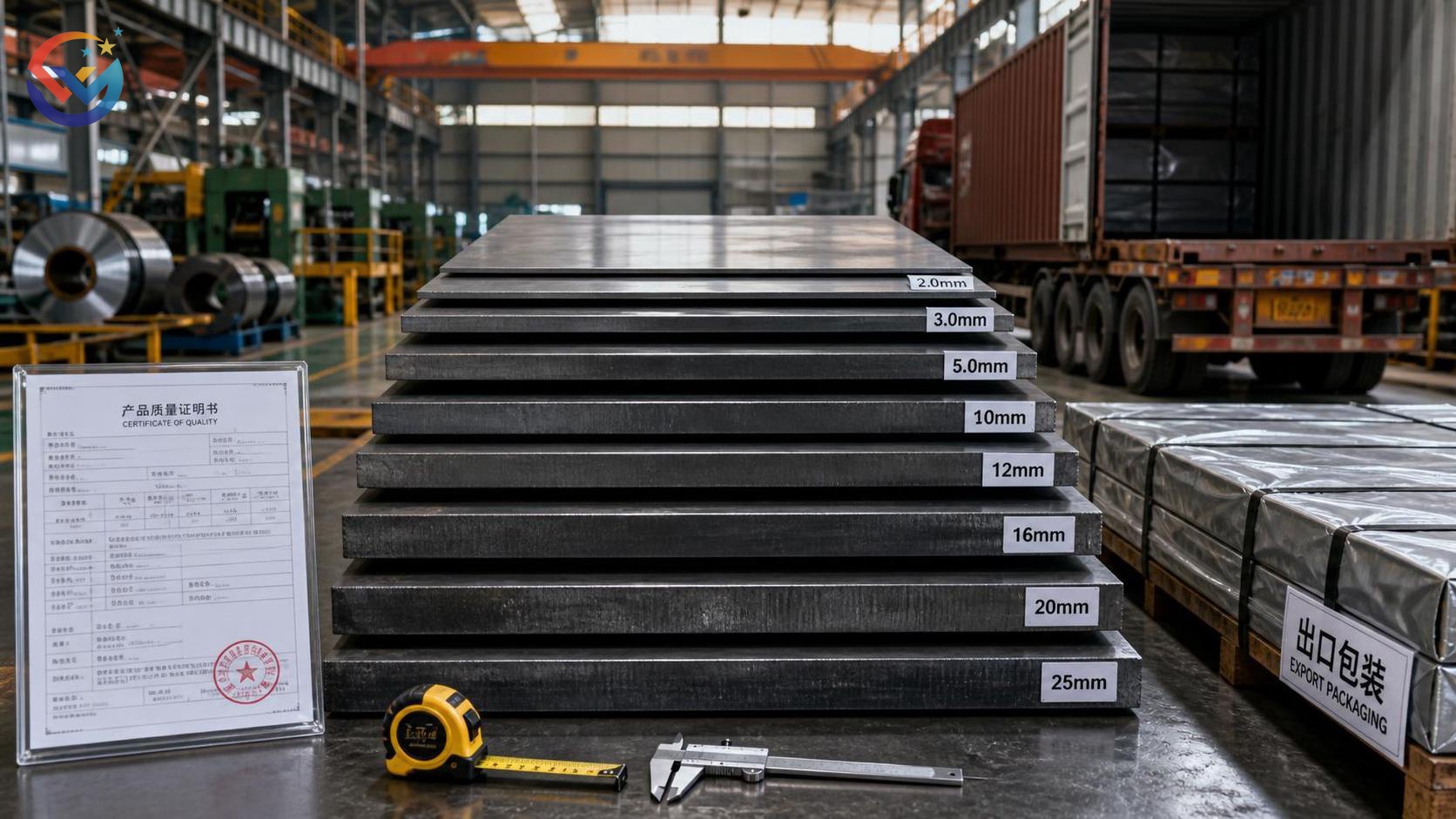
When sourcing Carbon Steel Plate, thickness is only one visible line item in the quotation. In practice, price differences usually come from grade, rolling route, tolerance control, surface quality, plate dimensions, mill source, testing requirements, and delivery terms.
For purchasing professionals, the right comparison is not “who offers the lowest price per ton,” but “which offer gives the lowest total procurement risk and the most usable steel for the application.” That is where better decisions and better margins are made.
Why Thickness Alone Does Not Explain Carbon Steel Plate Pricing
Many buyers begin with thickness because it is easy to specify and easy to compare. However, two plates with the same thickness can carry noticeably different prices if they differ in chemistry, manufacturing method, flatness, width and length accuracy, or inspection level.
This matters because procurement cost is not limited to invoice value. A cheaper plate may create hidden losses through low yield, difficult cutting, rework, delayed fabrication, failed inspections, or faster wear in service. Buyers who compare only thickness often discover those costs too late.
In competitive steel markets, the better approach is to compare price against actual use value. That means asking what the plate must do in production, what standards it must meet, and how much inconsistency your operation can tolerate.
Start With Grade, Not Just Dimensions
One of the biggest price drivers for Carbon Steel Plate is grade. Buyers sometimes compare offers that look similar in size but are based on different material standards, carbon content ranges, or mechanical property requirements.
For example, a general structural plate and a plate intended for pressure vessels or higher-strength fabrication will not be priced the same. Even when dimensions match, stronger or more tightly controlled grades usually involve stricter production control and more testing.
Procurement teams should confirm the exact standard, equivalent grade, and end-use requirement before evaluating price. If grade substitution is allowed, this should be reviewed carefully with engineering or production teams, not assumed during sourcing.
A lower-priced offer loses its value quickly if it cannot pass customer approval, welding procedures, or downstream inspection. Grade alignment is therefore the first filter in any serious comparison.
Hot Rolled vs. Further Processed Plate: Know What You Are Paying For
The rolling and processing route has a direct impact on cost. Standard hot rolled plate is typically the baseline, but additional processing such as leveling, trimming, shot blasting, coating, or precision cutting can change the final unit price significantly.
Some buyers treat these services as optional extras. In reality, they may reduce total cost by improving usability at the fabrication stage. A plate that arrives flatter, cleaner, and closer to final dimensions may save labor, machine time, and scrap.
This is especially important for manufacturers and contractors working on strict schedules. If the supplier can provide cutting, edge preparation, or customized dimensions before shipment, the quoted price may be higher per ton but lower in total project cost.
Purchasing decisions should therefore compare “delivered readiness,” not just base steel price. Ask what is included in the offer and what work your own facility would otherwise need to absorb.
Dimensional Tolerance Affects Yield, Waste, and Fit-Up
Tolerance control is often overlooked during quotation review, yet it has a measurable impact on fabrication efficiency. Two Carbon Steel Plate offers may share the same nominal thickness, width, and length while delivering very different actual dimensional consistency.
Tighter tolerance usually costs more because it requires stronger process control. But for buyers supplying equipment manufacturing, steel structures, machinery parts, or batch production, this added precision can reduce cutting loss and improve assembly fit.
Loose thickness tolerance may also create problems in welding, machining, or load calculations. If the application is sensitive to weight, pressure, or structural performance, dimensional variation is not a minor issue; it is a cost and compliance issue.
Ask suppliers to state tolerance standards clearly in the quotation. It is much easier to compare offers when tolerance is visible rather than hidden behind a nominal size description.
Surface Condition Is More Than a Cosmetic Issue
Surface quality affects both immediate processing cost and final product performance. Scale, rust level, pitting, lamination risk, edge damage, and plate flatness can all influence how much preparation is needed before cutting, welding, painting, or forming.
For some applications, standard mill surface is acceptable. For others, especially where coating quality, appearance, or precision fabrication matters, poor surface condition creates additional labor and rejection risk. That risk should be priced into procurement decisions.
A lower quotation may reflect less selective surface control or weaker storage conditions. Buyers should check whether the material is supplied as rolled, pickled, blasted, oiled, or otherwise treated, and whether packaging is suitable for export and local handling conditions.
In cross-border procurement, storage and transit time can further affect delivered condition. Surface quality at loading is not always the same as surface condition at arrival, so packaging and logistics should be reviewed together.
Mill Origin and Supply Chain Stability Influence the Real Buying Cost
Mill source is a major factor behind price differences in the steel trade. Plate from leading mills with strong quality systems, stable chemistry control, and recognized certification often carries a premium compared with material from less consistent sources.
That premium is not always necessary, but it is often justified when the end user requires predictable mechanical properties, full traceability, or acceptance in export-oriented projects. For many buyers, consistency across repeat orders matters more than the cheapest single shipment.
Procurement professionals should also distinguish between direct mill resources, trader stock, and mixed-origin cargo. The quoted price may look attractive, but mixed supply can create variation in documents, dimensions, and performance within the same order.
Reliable suppliers reduce this risk by maintaining stable partnerships with qualified mills and controlling procurement channels. That becomes especially valuable when markets are volatile and replacement material is difficult to secure quickly.
Certification, Testing, and Traceability Add Cost but Reduce Exposure
Testing requirements are another reason why one Carbon Steel Plate quote is higher than another. Mill test certificates, third-party inspection, ultrasonic testing, impact testing, chemical verification, and special documentation all add direct or indirect cost.
From a purchasing perspective, these costs should be judged against project exposure. If the material is used in critical structures, pressure-related equipment, heavy machinery, or export projects with strict documentation, testing is part of risk control, not a procurement burden.
On the other hand, if the application is simple and internal, over-specifying tests may raise cost without adding meaningful value. Buyers should match inspection level to real application needs and contract obligations.
The best supplier conversations happen when documentation expectations are clarified early. Late-stage requests for extra testing or revised certificates often increase lead time and create avoidable commercial friction.
Plate Size Strategy Can Be as Important as Plate Price
Experienced buyers do not only compare price per ton; they also compare how plate size affects downstream yield. Standard stock sizes may be cheaper, but they can generate more offcuts if they do not match the nesting plan or fabrication layout.
Custom width and length may appear more expensive at first glance. However, if they reduce scrap, cutting hours, and handling frequency, the total economics may improve. This is particularly relevant for batch production and project-based manufacturing.
Procurement teams should work closely with production planners before placing orders. The correct question is not simply “What is the cheapest plate?” but “Which size gives us the highest usable output after cutting and processing?”
That single change in comparison logic often leads to better purchasing decisions than negotiating a small discount on tonnage price alone.
Delivery Terms, Freight, and Inventory Timing Can Change the Best Offer
For international and domestic buyers alike, logistics has become a larger share of steel procurement cost. Freight mode, loading efficiency, port handling, inland transport, packaging, and Incoterms can all reshape the final landed cost of Carbon Steel Plate.
A lower ex-works price may become less competitive after transport, customs handling, and local delivery are added. Meanwhile, a supplier with warehousing, cutting capacity, and organized logistics may offer a higher unit rate but a smoother and faster supply cycle.
Lead time also has a cost. If delayed delivery disrupts production, the financial impact can exceed any saving achieved through a low initial quote. Buyers should evaluate stock availability, production cycle, shipment reliability, and contingency options before awarding orders.
For projects with staged demand, partial delivery planning can also matter. A supplier able to support scheduled release, warehousing, or mixed-container loading may create much more value than one offering only a lower headline price.
How Procurement Teams Should Compare Carbon Steel Plate Quotations
The most effective quotation review is structured and consistent. Buyers should compare offers across the same checklist: grade, standard, rolling condition, tolerance, surface quality, plate size, certification, origin, quantity basis, Incoterm, packing, lead time, and payment terms.
This prevents false comparisons where one supplier appears cheaper only because key requirements are omitted or assumed. It also helps procurement teams explain decisions internally to engineering, finance, and project stakeholders.
A practical method is to separate price into three layers: material cost, processing and compliance cost, and delivery cost. Then add a fourth layer for risk, including consistency, documentation reliability, and replacement difficulty.
Once this is done, the “best” quote often changes. The lowest price per ton may still win, but only after it has survived a full commercial and technical comparison.
Questions Buyers Should Ask Before Finalizing an Order
Before confirming any supplier, purchasing teams should ask a few direct questions. Is the offered grade exactly compliant with the required standard? What tolerance standard applies? What surface condition will be delivered? Are MTCs and third-party inspection available if needed?
They should also confirm whether the plate comes from a single mill source, whether customized cutting is possible, how export packing is handled, and what the realistic lead time is under current production conditions.
Another useful question is whether the supplier can support repeat orders with the same specification and quality level. In procurement, consistency across shipments is often more valuable than one-time pricing advantages.
These questions help expose hidden differences between offers early, when negotiation is still possible and before production schedules are committed.
What Smart Buyers Ultimately Optimize
Professional buyers do not optimize for the lowest visible price. They optimize for usable steel, reliable delivery, acceptable risk, and stable total cost over time. That is the right framework for evaluating Carbon Steel Plate in real procurement environments.
Thickness remains important, but it is only the starting point. Grade suitability, process route, tolerance consistency, surface quality, certification, mill origin, and logistics terms often explain more about value than thickness ever can.
In today’s steel market, the strongest purchasing results come from comparing quotations in the context of fabrication reality and supply chain reliability. Buyers who use that broader view are better positioned to avoid hidden cost and secure dependable material.
When comparing Carbon Steel Plate, look beyond the numbers in the first line of the quote. The more complete your comparison, the more confident your sourcing decision will be.
Navigation
Message
Please give us a message