Selecting a Wear Resistant Steel Plate for high-impact mining equipment is rarely a matter of choosing the highest hardness number on a datasheet. In mining service, plates are exposed to a mix of sliding abrasion, gouging wear, repeated impact, vibration, and often difficult field repairs. A plate that performs well in a chute liner may fail early in a dump truck body or crusher liner if the impact profile, forming requirements, or welding conditions are different. For technical evaluators, the real task is to match material behavior to failure mode, fabrication route, and replacement economics.
That is why the evaluation process should begin with the equipment and duty cycle, not with grade names alone. When a mine operator says a component “wears out too fast,” the root cause may be abrasive loss, impact cracking, deformation, poor fit-up, weak weld zones, or inconsistent plate quality from batch to batch. Those are different problems, and they do not point to the same steel choice.
Start with the wear mechanism, not the catalog
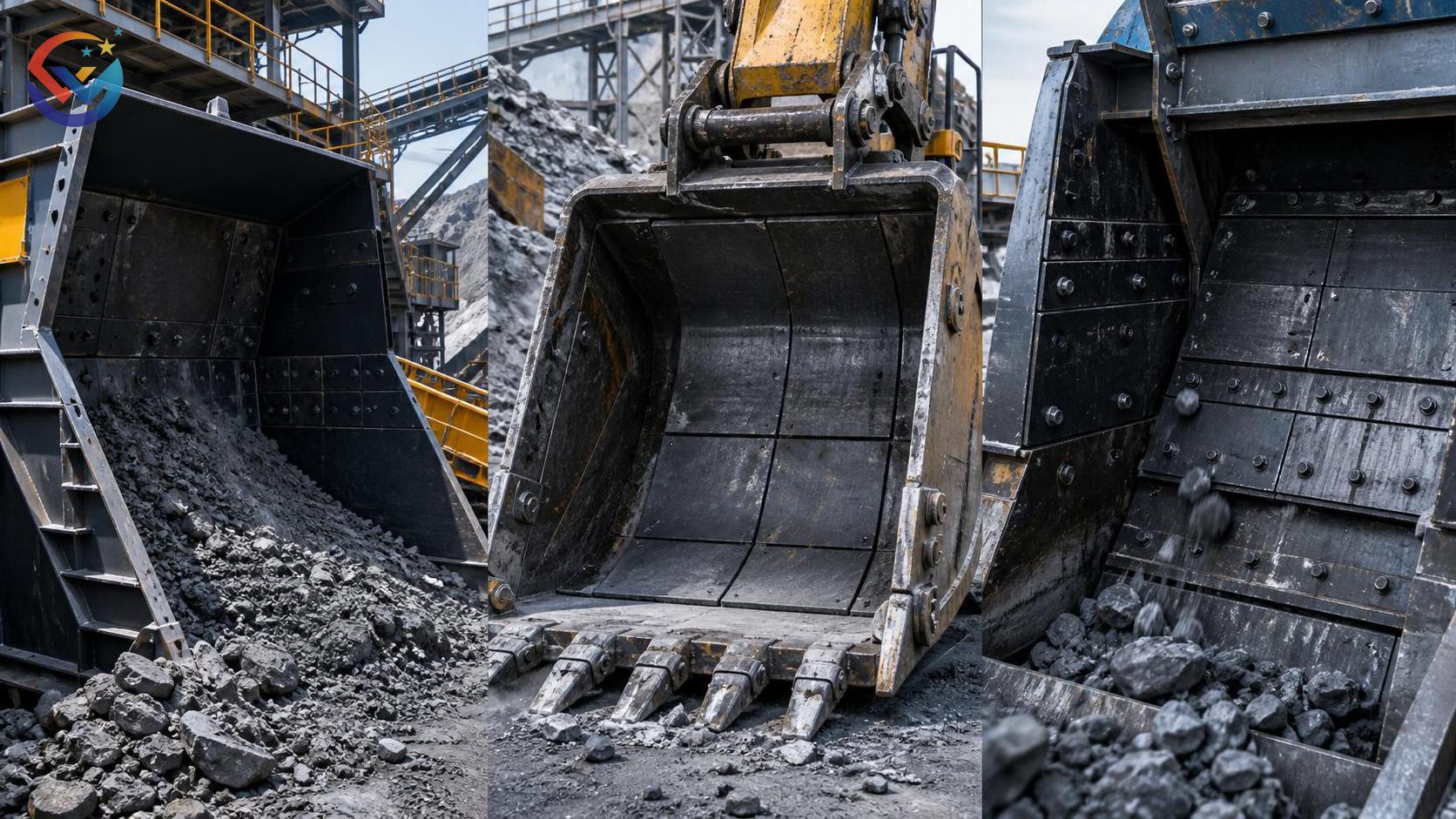
High-impact mining equipment usually operates in more than one wear regime at the same time. A hopper liner may see abrasive fines continuously, then occasional large rock strikes. An excavator bucket liner may experience severe localized impact at the lip and more moderate sliding wear along the bottom. A transfer chute can suffer impact at the loading zone and abrasion downstream. If the selection process treats all of these as generic “wear,” the plate specification is likely to be either overbuilt in the wrong direction or under-protected where failure actually begins.
In practice, technical teams should separate the application into a few basic questions:
- Is the dominant damage mode sliding abrasion, gouging abrasion, or impact-assisted abrasion?
- Are failures caused by thickness loss, cracking, denting, or weld joint failure?
- Is the plate used as a sacrificial liner, or as a structural wear member that also carries load?
- Will the part require cold forming, machining, or extensive welding before installation?
- Does the mine replace the whole part, or rebuild it repeatedly in the field?
This matters because a harder plate does not automatically mean a longer service life. Under severe impact, very high hardness can become a liability if toughness is insufficient for the section thickness and working temperature. On the other hand, specifying a lower-hardness, easier-to-fabricate plate for a purely abrasive zone may reduce initial processing cost but drive up shutdown frequency and total lifecycle cost.
Hardness is important, but it is not the whole decision
Wear plate selection often starts with nominal hardness ranges such as 400 HB, 450 HB, 500 HB, or above. That is a useful first filter, but not a complete engineering basis. Hardness generally correlates with abrasion resistance, especially in sliding wear environments, yet mining applications with high impact need a better balance between hardness and toughness.
A practical way to think about it is this: if the application is dominated by fine-particle abrasion and low impact, moving to a higher hardness grade may deliver clear gains. If the application involves repeated rock impact, drop loading, or stress concentration around bolt holes and welds, the incremental benefit of higher hardness may be offset by higher cracking risk or more difficult fabrication.
Technical evaluators should ask suppliers for more than a nominal hardness label. At minimum, the review should cover:
- Actual hardness range and through-thickness consistency
- Impact toughness data, where available, especially for thicker plates or low-temperature service
- Chemical composition approach, including carbon equivalent implications for weldability
- Heat treatment route and stability of mechanical properties
- Flatness, thickness tolerance, and surface condition
Where impact severity is high, a plate with slightly lower nominal hardness but more reliable toughness and fabrication performance can outperform a harder grade in real service. This is especially true when failure tends to initiate at cut edges, formed corners, or heat-affected zones.
Thickness selection is a failure-mode decision
Many buyers focus on grade first and thickness second, but in mining equipment the two should be considered together. Increasing thickness may extend service life by adding wear allowance, but it also changes weight, forming difficulty, welding procedures, and load distribution. In truck bodies, buckets, and hoppers, excess thickness can alter payload efficiency or shift stress to adjoining components. In liners, too much thickness may reduce usable internal volume or complicate fit-up.
More importantly, thickness interacts with toughness. A grade that performs acceptably at moderate thickness may not behave the same way in much heavier sections, especially under shock loading. For thick plate used in crusher liners, transfer points, or shovel components, evaluators should be careful about assuming that mechanical behavior scales linearly.
If historical maintenance data is available, it is often more useful than generic performance claims. Look at where the last component failed first. If the part still had residual thickness but cracked around welded areas, adding thickness alone will not solve the problem. If the part wore evenly and predictably with no structural damage, then thickness optimization may be the most direct lever.
Fabrication constraints often decide what is truly usable
One of the most common mistakes in selecting wear plate is approving a grade based on service performance alone, without fully accounting for fabrication. Mining equipment rarely uses raw plate as-is. It is cut, bent, rolled, welded, drilled, machined, and sometimes repaired in field conditions that are far from ideal.
For that reason, the usable material is not simply the one with the best lab wear resistance. It is the one that can be processed consistently into the final component without introducing hidden failure points.
Key fabrication checks include:
- Forming radius: Higher hardness grades generally require larger minimum bend radii and tighter process control. If your part geometry is aggressive, the fabrication limit may rule out some grades.
- Weldability: Preheat, interpass temperature control, filler selection, and hydrogen management become more critical as hardness and carbon equivalent rise.
- Cut edge quality: Thermal cutting can create hardened edge zones or microcracking if parameters are not controlled.
- Hole-making and machining: Very hard plate can increase tool wear and production time, affecting total part cost.
- Field repairability: Some mining operations depend heavily on onsite welding and patch repair. Materials that demand strict procedures may not be ideal in remote conditions.
This is where supplier capability matters as much as plate chemistry. A company that works across production, cutting, processing, warehousing, and delivery can often reduce variation between the mill certificate and the installed part. For buyers sourcing internationally, especially from China, the real question is not only where the steel originated, but whether the processor can maintain dimensional control, traceability, and batch consistency through fabrication and shipment.
Watch the heat-affected zone and edge condition
In high-impact mining applications, early failures frequently start at edges, corners, weld toes, and bolt locations rather than on the broad plate surface. That is why evaluating only base material properties is insufficient. The heat-affected zone can become the weakest link if the welding procedure is not matched to the plate’s hardenability and thickness.
Technical teams should be wary of the common assumption that “wear plate is wear plate” as long as hardness meets the requirement. In reality, two plates with similar nominal hardness can behave quite differently after cutting and welding. Differences in alloy design, cleanliness, heat treatment control, and processing guidance show up during fabrication and service, not always in a simple brochure comparison.
When assessing a candidate material, it is reasonable to request or verify:
- Recommended preheat and welding procedures for the specific thickness range
- Guidance on plasma, laser, or oxy-fuel cutting limits
- Whether post-cut edge grinding is advised in high-stress areas
- Any restrictions on forming after cutting or after welding
- Material test certificates and traceability by heat or plate batch
If the equipment design contains sharp transitions or welded attachments in impact zones, improving edge preparation and weld design may create more service-life gain than moving up one hardness class.
Do not treat all mining applications as the same
Mining equipment covers a broad range of duty conditions, and the right specification for one component can be wrong for another. A useful evaluation framework is to group applications by dominant service conditions rather than by equipment category alone.
The point is not to force a single grade across the entire machine. In many mining systems, the better approach is zoned specification: use tougher, more impact-tolerant plate in strike areas and harder, more abrasion-focused material where sliding wear dominates. That may complicate procurement slightly, but it usually reflects actual service conditions better than a one-grade-for-all policy.
Quality consistency matters more than headline performance
For technical evaluators, inconsistent plate quality is often a larger operational risk than slightly lower peak performance. If one batch forms cleanly and the next shows edge cracking, or if hardness varies significantly through thickness, maintenance planning becomes unreliable. In mining operations where shutdown windows are tight, predictability is valuable.
This is why the supplier review should go beyond price and availability. Ask how the material is sourced, whether the supplier has stable relationships with major mills, what processing is done in-house, and how traceability is maintained from original plate to shipped parts or cut blanks. Large-volume suppliers with established mill partnerships can sometimes offer better continuity across orders, but that should still be verified through documents, trial orders, and feedback from actual processing.
For overseas buyers, logistics capability also affects technical outcome. Poor packaging, mixed lots, unclear marking, or long lead-time variability can disrupt repair schedules just as much as a material mismatch. A wear plate procurement decision is therefore partly a supply-chain decision.
Questions worth asking before approval
Before freezing the specification, technical evaluators should be able to answer a few practical questions with confidence:
- What is the actual failure mode of the current component?
- Is the target improvement wear life, crack reduction, lower weight, easier repair, or lower total cost?
- Can the selected plate be cut, formed, and welded within existing shop capability?
- Are welding procedures and field repair conditions realistic for this material?
- Is the supplier able to deliver consistent properties, not just compliant paperwork?
- Would a trial in one wear zone provide faster learning than a full-spec conversion?
That last point is often overlooked. In mining service, controlled field trials are usually more informative than theoretical comparisons. A side-by-side test on a high-consumption wear part can reveal whether the proposed plate improves not only wear life, but also crack behavior, maintenance hours, and replacement predictability.
Common evaluation traps
Several assumptions regularly distort wear plate decisions in mining:
- “Higher hardness always lasts longer.” Often true in low-impact abrasion, not universally true in impact-heavy duty.
- “Any processor can handle hard plate.” Processing quality varies widely, especially for thick or high-hardness material.
- “Mill certificate data is enough.” Base material data does not fully predict fabricated-part performance.
- “A successful grade on one machine will work everywhere.” Wear mechanisms change by location, ore type, drop height, moisture, and maintenance practice.
- “Lowest purchase price reduces cost.” In mining, downtime, labor, and replacement frequency usually dominate the economics.
A disciplined evaluation should therefore compare candidates on installed performance and total operating effect, not just on nominal specification and ton price.
What a sound decision usually looks like
In most high-impact mining applications, the best decision is not the most extreme material available. It is the plate that fits the real wear mechanism, survives fabrication without hidden damage, and can be supplied consistently enough to support maintenance planning. For some components, that will mean choosing a mid-to-high hardness plate with strong toughness and good weldability. For others, it may mean combining different materials across wear zones or accepting slightly lower hardness to gain reliability in impact service.
Buyers evaluating global supply options should also weigh the practical strengths of the supply base. Producers and integrated processors with established mill partnerships, broad stock access, and in-house cutting or customization can be useful when projects require both specification control and delivery flexibility. That can matter as much as the grade itself when mining schedules are tight and replacement parts are not easily delayed.
In the end, selecting a Wear Resistant Steel Plate for high-impact mining equipment is less about finding the “best” plate in abstract terms and more about identifying the plate that fails least expensively, least unpredictably, and least often in your actual operating environment.
Navigation
Message
Please give us a message