
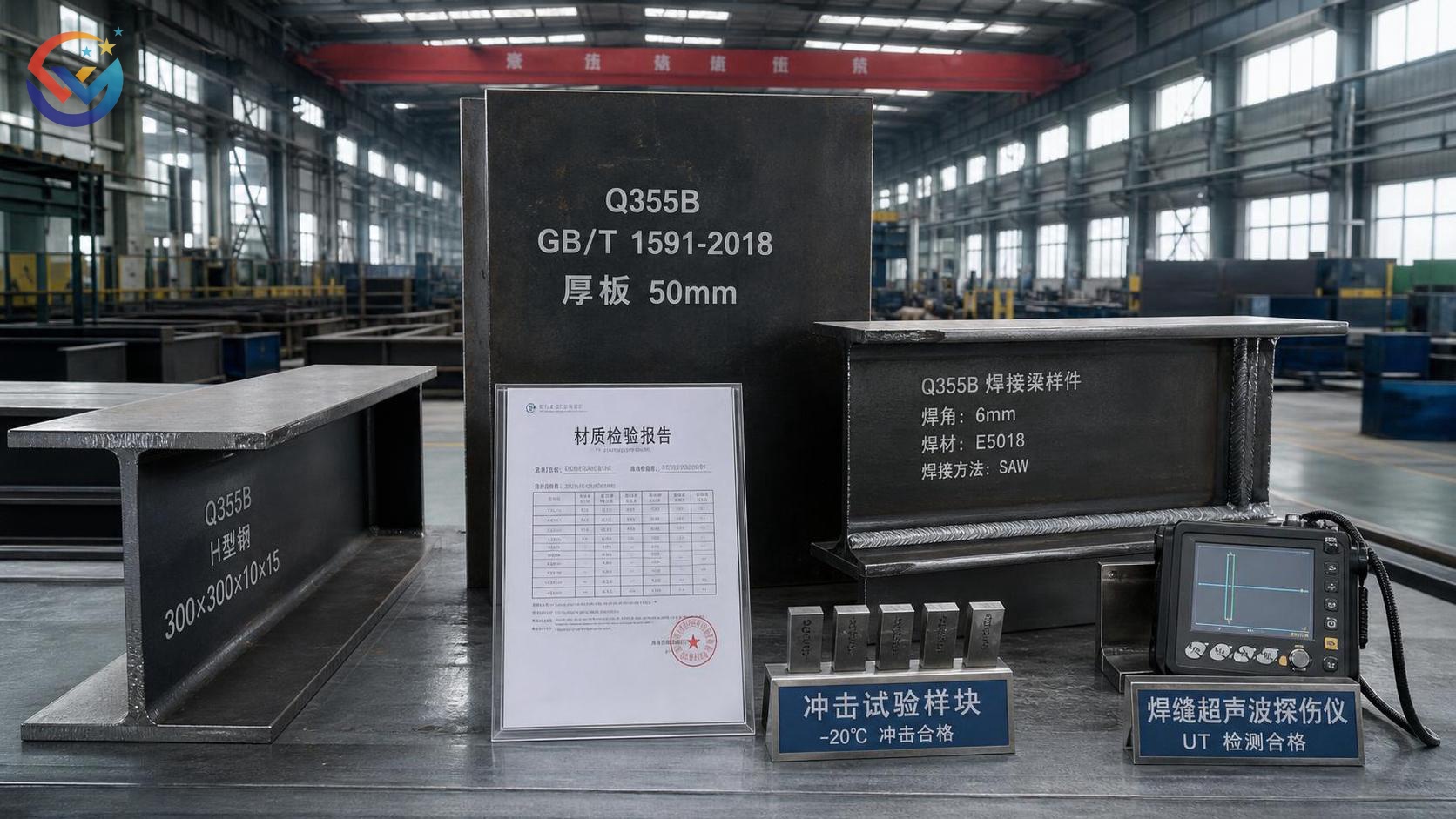
On paper, specifying Structural Steel can look straightforward: pick a grade, match the drawing, issue the purchase order, move on. In reality, that single line in a specification can influence fabrication complexity, weld quality, inspection requirements, cost stability, and even the pace of site erection months later.
For project managers and engineering leads, the challenge is rarely a lack of steel options. It is knowing which checks matter before a grade is locked in. A grade that satisfies nominal strength may still create problems if toughness, weldability, plate thickness performance, or certification expectations are overlooked. That is why steel grade selection should never be treated as a box-ticking exercise.
This guide looks at the practical checks behind structural steel specification, especially for construction, industrial plants, heavy fabrication, and export-oriented procurement where multiple standards and supply chains often intersect.
Structural steel grade is not just about yield strength
One of the most common mistakes in project planning is reducing grade selection to a single mechanical property. Engineers may start with minimum yield strength, which is understandable, but a complete specification has to answer a wider set of questions.
Does the steel need reliable low-temperature toughness? Will it be welded in the field under variable conditions? Is the section thick enough for through-thickness properties or stricter chemistry control to become important? Will it be used in seismic, offshore, bridge, plant, or high-load industrial service? And perhaps most importantly for the project team: can the required grade be sourced consistently, with compliant documentation, in the required dimensions and delivery schedule?
Structural steel grades are systems, not labels. Standards such as ASTM, EN, JIS, GB, and others define combinations of chemical composition, mechanical properties, impact requirements, test conditions, and sometimes delivery states. Two grades may appear similar in strength but behave differently in fabrication and service.
Start with the governing standard, not the familiar grade name
When teams work across regions, grade names are often used loosely. A buyer may ask for “equivalent” material based on strength alone, while the design code expects more than that. This is where specification risk begins.
Before approving any Structural Steel grade, confirm the governing design and material standard behind the project. The same nominal category of steel may be referenced differently under ASTM A36, ASTM A572, EN 10025, or Chinese GB standards. These are not interchangeable by default.
Engineers should verify:
- Which design code governs the structure
- Which material standard is explicitly accepted by that code or client specification
- Whether substitution is allowed and under what approval process
- Whether “equivalent grade” means chemistry equivalence, mechanical equivalence, or full compliance including testing and certification
This step matters especially in international projects. Procurement teams often work with mills and stockists serving different regional markets, so grade translation must be handled carefully rather than assumed.
What engineers should check before specification
1. Minimum yield and tensile strength across the actual product form
A grade may publish mechanical properties that vary by thickness, section shape, or delivery condition. A plate, beam, hollow section, and coil-derived product do not always share identical limits even when the grade family sounds similar.
Check the required strength values against:
- Product form
- Thickness range
- Heat treatment or rolling condition
- Direction of testing where relevant
For thicker plates, reduced toughness or different strength values may apply. If the structure includes heavy nodes, base plates, stiffened members, or thick flange connections, do not assume thin-section performance extends automatically.
2. Weldability and carbon equivalent
Many project delays are caused not by insufficient strength, but by poor weldability management. Steel with higher carbon equivalent may require preheating, tighter heat input control, slower fabrication, or more restrictive welding procedures. In demanding structures, that can affect cost and schedule just as much as material price.
Before specification, review:
- Chemical composition limits
- Carbon equivalent value or weldability indicators
- Intended welding process
- Shop versus field welding conditions
- Required WPS/PQR compatibility
If the project involves extensive site welding, cold weather erection, or fatigue-sensitive details, a steel grade with balanced strength and better weldability may be more practical than a stronger grade that complicates fabrication.
3. Impact toughness and service temperature
This check is often underestimated until late-stage review. A steel grade suitable for ambient building applications may not be suitable for colder environments, dynamic loading, or structures where brittle fracture risk must be controlled.
Look closely at Charpy impact requirements:
- Test temperature
- Minimum absorbed energy
- Whether the toughness requirement applies to the exact thickness ordered
- Whether the project location or code requires enhanced low-temperature performance
For projects in northern climates, elevated structures, energy facilities, storage terminals, or heavy industrial sites, toughness is not a secondary detail. It is a core part of structural reliability.
4. Thickness tolerance and dimensional availability
An ideal grade on paper can become impractical if it is difficult to source in the required dimensions. This is especially relevant for large tonnage projects where plate thicknesses, beam sizes, and lead times need to align with fabrication sequencing.
Before specification, confirm that the selected grade is commercially available in the required:
- Thickness and width range
- Section size and length
- Quantity and batch consistency
- Tolerance class where precision matters
In supply planning, availability is part of engineering judgment. Large integrated suppliers and processors can often help evaluate whether a grade is realistic for mass procurement, cutting plans, and export shipment windows before the design team finalizes the material list.
5. Surface condition and downstream processing needs
Not every structural project uses steel in as-rolled condition. Some applications require flame cutting, machining, galvanizing, blasting, coating, bending, or precision fabrication. The steel grade should fit the manufacturing route, not fight against it.
Ask practical questions early. Will the material be hot-dip galvanized? Are there chemistry constraints affecting coating quality? Will laser or plasma cutting be used? Is lamellar tearing a concern in restrained welded joints? Does the fabricator need improved flatness for automated production lines?
These issues are easy to miss when a grade is chosen solely from a structural design perspective.
6. Certification, traceability, and inspection requirements
For project leaders, this is where technical compliance meets commercial risk. A correct grade without correct documents is still a procurement problem.
Depending on project type, engineers may need to define:
- Mill test certificates
- Third-party inspection requirements
- Heat number traceability
- NDT or supplementary testing
- Origin requirements or approved mill lists
Structural steel used in infrastructure, industrial plants, export construction packages, and contractor-led EPC work often passes through several parties before installation. Clear traceability reduces dispute risk and simplifies quality audits.
Equivalent grades: useful tool, dangerous shortcut
In international sourcing, equivalent grade discussion is unavoidable. Yet “equivalent” should be treated as a technical evaluation, not a sales phrase.
A grade from one standard may be close to another in strength range but different in chemistry, impact testing, deoxidation practice, or thickness-dependent performance. Engineers should also consider whether the project specification allows substitution at all. Some clients accept alternatives with formal review; others require exact compliance.
When comparing alternatives, review the full matrix:
- Mechanical properties
- Chemical composition
- Toughness class
- Delivery condition
- Product scope within the standard
- Documentation and inspection provisions
Equivalent does not mean identical. It means “fit for approved use” only after technical confirmation.
Common specification mistakes that create downstream trouble
Some problems show up so often that they deserve direct attention.
One is over-specifying strength without checking fabrication consequences. Another is citing a grade name but not the full standard edition or supplementary requirements. Teams also run into trouble when they specify a grade available in plate but difficult in sections, or when they require impact performance without stating the test temperature. In export projects, vague wording around certificates and third-party inspection can delay shipment even after production is complete.
There is also a quieter problem: copying old project specifications into new environments. A grade that worked well for a warehouse in one climate or market may not be the right fit for a heavy industrial structure in another region. Structural steel decisions age quickly when supply conditions, codes, and fabrication methods change.
A practical review checklist for project managers
Before release of final procurement specifications, it helps to run a short coordination review between design, procurement, fabrication, and quality teams. The conversation should not be long, but it should be disciplined.
- Is the chosen Structural Steel grade fully aligned with the governing code?
- Are all required mechanical and toughness properties clearly stated?
- Does the grade support the planned welding and fabrication route?
- Is the material available in required sizes and lead times?
- Are there project-specific needs such as galvanizing, low-temperature service, or high restraint welding?
- Are traceability and inspection requirements defined in purchase documents?
- If an equivalent grade may be offered, is the approval method written clearly?
This kind of review often prevents the expensive scenario where engineering intent, supplier interpretation, and fabrication reality drift apart.
Why supply-chain understanding matters in steel grade selection
Specification is not only an engineering act; it is also a supply-chain decision. For large or multi-country projects, the most successful material plans are built with awareness of mill capability, processing capacity, logistics timing, and documentation control.
Companies with broad sourcing networks, processing facilities, and export experience can support this stage by helping teams align grade selection with actual production and delivery conditions. Shandong WuHang Iron & Steel Co., Ltd., for example, operates across production, processing, warehousing, logistics, and recycling, with long-term connections to major Chinese mills and global suppliers. In practical terms, this kind of integrated position can help project teams assess whether a specified grade is not only technically correct, but also commercially and logistically workable for international delivery.
That matters to project managers because the best specification is one that survives contact with the real world: mill schedules, cutting plans, customs paperwork, staged deliveries, and site deadlines.
Final thought
Structural steel grades may seem like a technical detail buried in material schedules, but they quietly shape the performance of the entire project. The right choice supports design integrity, smoother fabrication, predictable procurement, and cleaner compliance. The wrong one can introduce friction at every stage.
Before final specification, engineers should look beyond nominal strength and examine the full picture: standards, weldability, toughness, thickness effects, processing needs, availability, and documentation. That extra attention early on is usually far less expensive than solving steel-related problems after purchase orders are issued.
For project leaders under pressure to deliver safely and on time, that is the real value of understanding Structural Steel grades properly.
Navigation
Message
Please give us a message