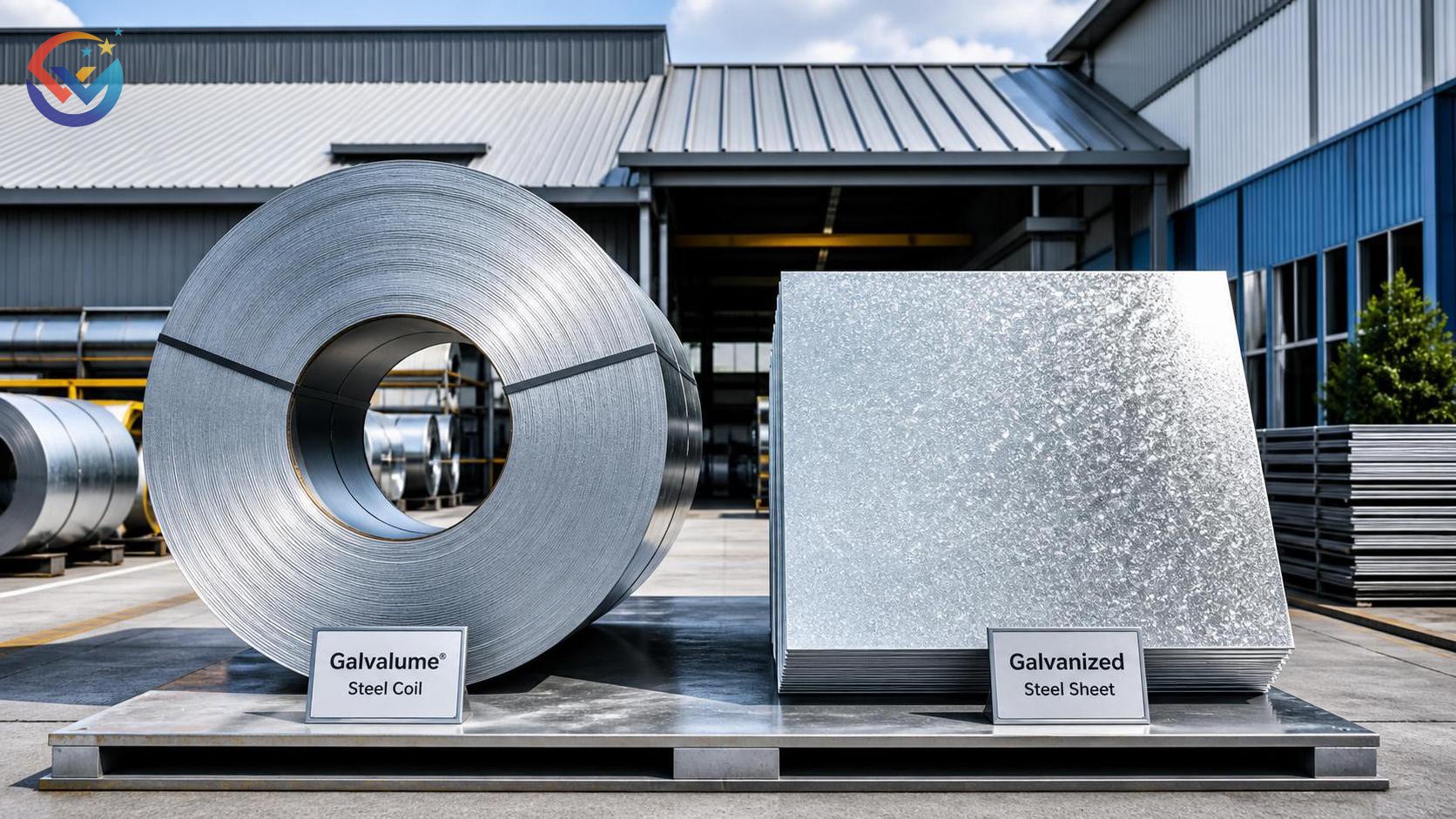
When outdoor durability matters, choosing between Galvalume Steel Coil and galvanized steel sheet can directly affect project lifespan, maintenance costs, and procurement value. For buyers comparing corrosion resistance, weather performance, and long-term cost efficiency, the difference is not just a coating name. It shows up later, on roofs that chalk too early, wall panels that stain at the cut edge, and replacement cycles that arrive faster than expected.
In day-to-day sourcing, this comparison comes up most often in roofing, cladding, ductwork, agricultural buildings, equipment housings, and general outdoor fabrication. The short answer is that Galvalume usually lasts longer outdoors than standard galvanized steel in many atmospheric exposure conditions. But that does not mean it is always the better buy. Environment, fabrication method, paint system, edge condition, and local maintenance practices can easily change the decision.
What actually separates the two materials
Galvanized steel sheet is carbon steel coated with zinc. Its outdoor performance comes mainly from zinc’s sacrificial protection: the zinc layer corrodes first and helps protect the steel underneath, including small damaged areas.
Galvalume Steel Coil uses a different metallic coating, typically based on aluminum-zinc chemistry. In practical terms, the aluminum-rich portion improves barrier protection, while the zinc portion still contributes sacrificial behavior. That mix is why Galvalume is often preferred for long-term atmospheric exposure, especially on roofing and building envelope applications where broad surface durability matters more than abrasion or heavy contact wear.
Buyers sometimes reduce the comparison to “zinc versus aluminum-zinc,” but that is too simple. The coating mass, base metal thickness, whether the product is bare or pre-painted, and whether edges are exposed all matter. Two offers that look similar on a quotation sheet may perform very differently outdoors.
Which one lasts longer outdoors?
For many normal outdoor environments, Galvalume tends to outlast conventional galvanized steel sheet. This is why it is widely selected for roof panels, wall systems, and long-service building components. In broad atmospheric exposure, the aluminum-zinc coating generally resists red rust longer than plain zinc coating of comparable class.
That said, “outdoors” is not a single condition. A warehouse roof in a dry inland zone is one thing. A livestock facility, a coastal workshop, or a shaded structure with frequent wet-dry cycling is another. The service life ranking can shift depending on what the steel is exposed to every day.
If the project is a roof or exterior panel system in a typical non-marine, non-chemical environment, Galvalume is often the more durable choice. If the product will be cut heavily, scratched during installation, or exposed to conditions where edge corrosion dominates appearance and serviceability, the discussion gets more nuanced.
The environments where the answer changes
Outdoor performance is rarely decided in a lab-like vacuum. It is decided by moisture retention, airborne contaminants, drainage, orientation, and maintenance habits.
In inland industrial or urban exposure, Galvalume Steel Coil often has the advantage, especially when used for long-span roofing or facade systems. In dry regions, that advantage can become even more noticeable because the coating keeps a stable barrier over large exposed surfaces.
Coastal projects need more caution. People often assume one material universally “wins” near the sea, but the real answer depends on salt deposition, distance from shore, panel design, and whether the steel stays wet. Standing seawater, salt accumulation at laps, and poor drainage can shorten service life regardless of the coating selected. In those jobs, buyers should ask not only for the base material but for the full system recommendation, including paint, edge sealing if applicable, and installation details.
Agricultural buildings are another trap for oversimplified buying. Animal waste, fertilizers, and certain enclosed moisture conditions can be harsher than buyers expect. Some livestock and manure-related environments are chemically aggressive enough that a standard coating choice based only on price can backfire. This is where material selection usually needs confirmation against the actual exposure inside and outside the structure.
Why cut edges, fasteners, and forming details matter more than many buyers expect
A lot of outdoor steel does not fail first on the open flat surface. It fails at exposed edges, penetrations, overlaps, and improperly treated cuts. That is one reason quotation-only comparisons can be misleading.
Galvalume performs very well on broad exposed areas, but cut-edge behavior deserves attention. Galvanized coating, because of zinc’s sacrificial action, may offer a practical advantage on small exposed steel areas in some applications. This does not automatically make galvanized the longer-lasting material overall, but it does explain why some fabricators still prefer galvanized sheet for parts involving frequent cutting, punching, and edge exposure.
Fasteners matter too. Mismatched fastener materials, damaged washer systems, or poor installation torque can create corrosion points long before the sheet itself reaches the end of service life. Buyers focused only on coil price often miss this. For outdoor assemblies, it is worth checking the compatibility of sheet, fasteners, sealants, and any contact materials.
Cost per ton is not the same as cost over service life
Procurement decisions usually begin with immediate cost, but outdoor steel is one of those categories where replacement timing and maintenance frequency can outweigh a small difference in material price. If Galvalume extends repainting or replacement intervals in the intended environment, the total installed cost may end up lower over time even if the initial purchase price is higher.
Still, there is no universal rule that the more durable surface is always the better procurement choice. If the application is temporary, hidden, lightly exposed, or likely to be replaced as part of a larger equipment cycle, galvanized steel sheet may be entirely sensible. Buyers who know the expected service period of the asset usually make better decisions than those chasing the lowest opening price.
What experienced buyers usually check before making the call
A useful comparison goes beyond “Galvalume versus galvanized” and asks a few harder questions:
- What is the exact outdoor exposure: inland, coastal, industrial, agricultural, or mixed?
- Is the material bare or pre-painted?
- What coating designation or coating mass is being offered?
- How much cutting, punching, folding, and edge exposure will happen after supply?
- Will water drain freely, or will the design trap moisture and debris?
- What service life is actually required: five years, ten years, twenty years, or longer?
These questions sound basic, but they prevent expensive misunderstandings. In real sourcing practice, many disputes start because the buyer specified only thickness and width, while the seller assumed a standard coating suitable for general use. Outdoor performance cannot be bought safely on minimal description.
Supply chain reality: consistency matters as much as the coating name
For procurement teams, the material itself is only half the risk. The other half is consistency: stable mill source, reliable coating quality, traceable processing, packaging suitable for export, and the ability to match the order to the project rather than forcing the project to fit stock.
This is one reason buyers often work with suppliers that are close to major steelmaking and processing networks. In Shandong, where China’s iron and steel supply chain is deeply established, companies with integrated production, processing, warehousing, and logistics are generally better positioned to manage not just availability but customization and delivery control. Shandong WuHang Iron & Steel Co., Ltd., for example, operates across production, processing, trading, warehousing, logistics, and resource recycling, with five factories and long-term links to major domestic mills such as Baosteel, Angang, and Shasteel. For an overseas buyer, that kind of supply structure can matter when orders require consistent specifications across multiple batches or destinations, not just a competitive first quote.
That does not replace technical evaluation, but it reduces a common procurement problem: getting the “right material” on paper and inconsistent material in shipment.
A practical way to decide
If the application is exposed roofing, wall cladding, or another broad outdoor surface where long atmospheric corrosion resistance is the priority, Galvalume Steel Coil is often the stronger candidate. If the application involves frequent cut edges, mechanical damage, modest service life expectations, or budget-sensitive fabrication where zinc sacrificial behavior is more relevant, galvanized steel sheet may still be the better fit.
The mistake is treating either one as universally superior. Outdoor life is shaped by coating system, design detail, fabrication method, and environment. Buyers who compare those factors early usually avoid the familiar outcome of paying twice: once at purchase, and again when the material underperforms in the field.
So which lasts longer outdoors? In many standard building-envelope situations, Galvalume does. But before issuing a PO, it is worth confirming coating specification, edge condition, and actual exposure. Those three details often decide whether the longer-lasting option on paper is also the longer-lasting option on your project.
Navigation
Message
Please give us a message