
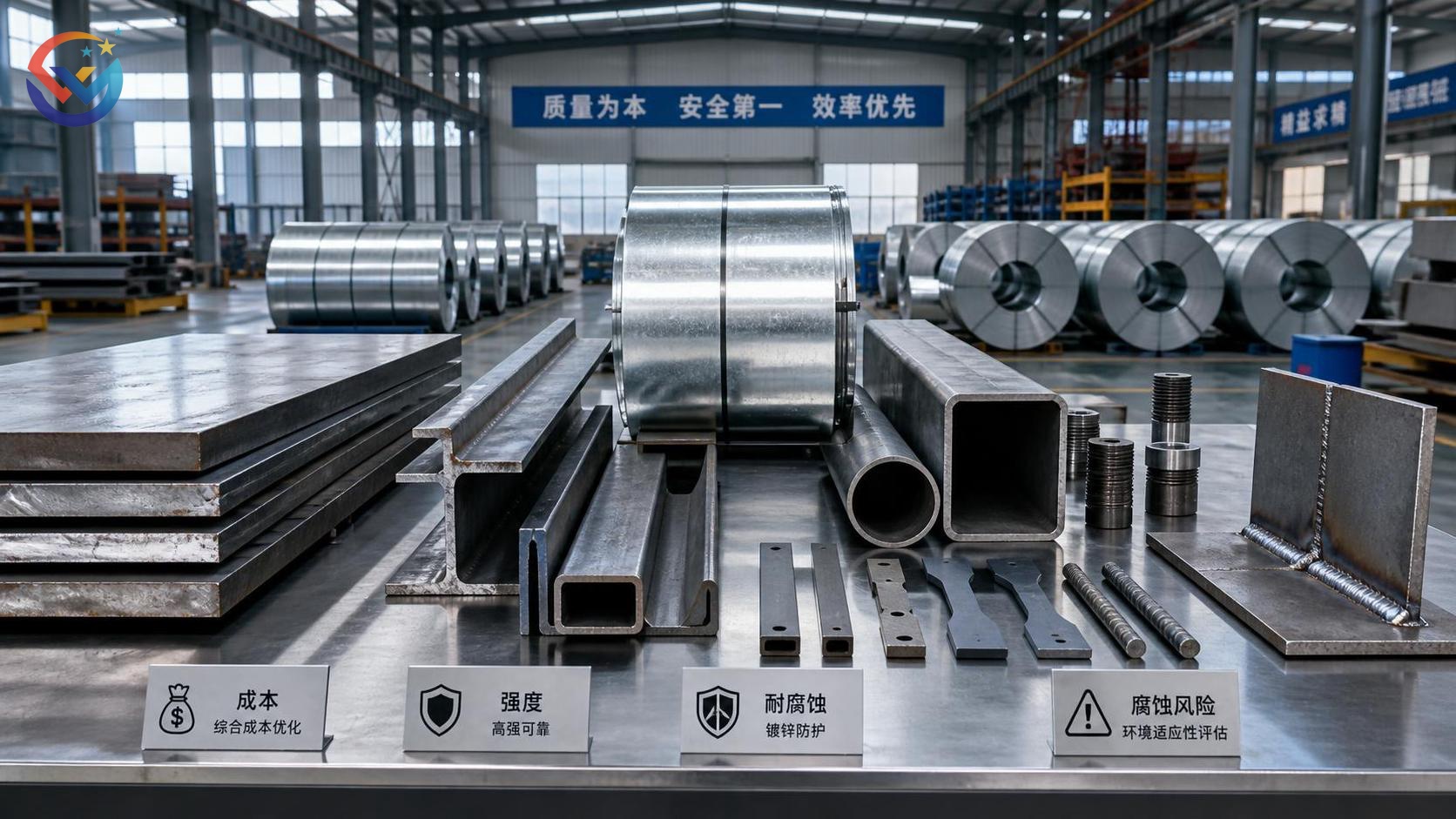
Material selection in industrial work usually fails for predictable reasons: the grade is chosen from a price sheet alone, the design load is treated as a single static number, or corrosion is reduced to a vague note such as “outdoor use.” A better decision starts by separating three questions that often get mixed together. First, what load must the component actually carry across its service life? Second, what environment will attack the surface, cut edges, weld zones, and fastener interfaces? Third, which form of supply can be processed, delivered, and installed without creating hidden cost later? When these questions are handled together, Metal Materials selection becomes a controlled engineering and commercial decision rather than a reactive substitution exercise.
Steel remains the default option in many projects because it offers a wide range of strength levels, thicknesses, surface conditions, and fabrication routes. But “steel” is too broad to be useful in purchasing or design review. Carbon steel plate, hot-rolled structural sections, galvanized coil, weathering steel, stainless sheet, abrasion-resistant plate, and alloy bars behave very differently once cutting, welding, forming, transport exposure, and field installation are considered. The most economical material on day one may become the most expensive once repainting, unplanned reinforcement, or premature replacement enters the picture.
Start with service conditions, not with the catalog
The environment should be translated into practical exposure categories before any grade is shortlisted. An indoor dry warehouse frame is not exposed in the same way as a coastal conveyor support, a fertilizer handling hopper, or a process-water pipe rack. Humidity alone is only part of the issue. Chlorides, acidic washdown, alkaline splash, trapped moisture under gaskets, cyclic wet-dry conditions, and contact with dissimilar metals all change the corrosion pattern. A material that performs adequately on an open, drainable surface may fail much faster at lap joints, bolted overlaps, or unsealed crevices.
This is why corrosion review should focus on details rather than only on bulk material type. For example, galvanized steel can be a rational choice where atmospheric exposure is moderate and the coating remains intact through fabrication and service. Yet if repeated abrasion removes the zinc layer, or if weld repairs are poorly restored, the expected protection drops sharply at exactly the locations where failure tends to start. Stainless steel may appear to solve the corrosion concern, but grade selection still matters because some stainless products perform poorly in chloride-rich conditions if the wrong alloy family is chosen or if surface contamination from carbon steel handling is not controlled.
Strength needs a full load picture
Mechanical performance should be defined in terms that match the actual component. Yield strength is often the first number compared, but it is rarely enough on its own. Sections subject to impact, repeated loading, vibration, low-temperature service, or wear may need closer attention to toughness, fatigue behavior, hardness, and weld heat-affected zone performance. A plate with higher nominal strength can permit thinner design, but thinner sections may deflect more, become harder to weld without distortion, or lose corrosion allowance that was quietly protecting service life.
For fabricated structures, the useful question is not whether a higher-strength grade exists. The useful question is whether that extra strength survives the whole production route. If the material requires tighter bending radii, stricter heat input control, special filler metals, or post-fabrication straightening, then a strength upgrade may shift cost from tonnage to processing. In some projects, a lower-strength but easier-to-fabricate steel produces a better installed result because weld quality, dimensional control, and coating reliability are easier to maintain.
Wear service creates another common misunderstanding. Abrasion-resistant plate is selected for hardness, yet the surrounding support members, weld consumables, and attachment details may not share that property. If a chute liner is very hard but the backing structure deforms under impact, the liner still cracks or loosens. Material selection should therefore cover the full assembly, including transitions between hard and ductile zones.
Cost should be measured across the asset, not only at purchase
Direct material price is visible immediately, while fabrication difficulty, coating repair, transport damage, downtime, and maintenance are often treated as separate budgets. That separation distorts comparison. A lower-cost carbon steel plate with a paint system may be fully acceptable in sheltered service with easy inspection access. The same combination may become expensive in an elevated marine installation where repainting requires shutdown, scaffolding, and weather windows. In that situation, a more corrosion-resistant metal or a heavier-duty initial protection system may have the lower total burden even if the purchase order value is higher.
Thickness availability also affects real cost. If a project specifies a plate thickness or width that is unusual in local mill rolling schedules, lead time can stretch and cutting yield can worsen. Standard stock sizes usually reduce scrap, speed nesting, and simplify replacement planning. Material decisions that align with common dimensions often protect schedule as much as budget.
It is also worth examining whether the selected form matches the fabrication route. Buying oversized plate for small precision parts can increase machining hours and offcut waste. Ordering pre-galvanized sheet for heavily welded assemblies can destroy the coating where most protection is needed. Sometimes the better path is plain material first, then post-fabrication surface treatment; in other cases, factory-coated product should be preserved by designing around minimal field alteration.
Where selection errors usually appear
- Specifications copied from an earlier job without reviewing exposure differences. A plant expansion beside a chemical wash area does not share the same corrosion profile as a dry storage annex, even if the geometry is similar.
- Equivalent grades assumed across regions without checking mechanical ranges, chemistry limits, and delivery condition. Two materials may look comparable in name yet behave differently during welding or impact service.
- Surface protection treated as separate from material choice. In practice, coating compatibility, blast profile, edge preparation, and repair method influence whether the base material will perform as expected.
- Connection details ignored. Fasteners, washers, welded attachments, and cut edges often determine durability more than the main plate or section.
- Transport and storage overlooked. Condensation under packaging, salt exposure in transit, and long outdoor laydown can damage the surface before installation begins.
Match material families to the service logic
Carbon steel is usually the baseline for structural frames, supports, machine bases, and general fabricated parts where loads are clear and corrosion can be managed by coating, galvanizing, enclosure, or inspection access. It offers broad processing flexibility and generally simpler sourcing in multiple forms. The risk lies in assuming that a basic painted carbon steel solution will remain economical in aggressive exposure.
Galvanized steel is often suited to outdoor structures, cable support systems, light-to-medium corrosion zones, and components where broad-area atmospheric protection matters. Its performance depends heavily on coating continuity and drainage detail. Deep crevices, heat-damaged areas, trapped moisture, and frequent mechanical wear can reduce the value of galvanizing if not addressed at the design stage.
Stainless steel becomes relevant when contamination, washdown, chemical splash, food-contact requirements, or difficult maintenance access make surface stability more important than first cost. Yet stainless is not a universal answer. Grade family, finish, fabrication cleanliness, and chloride exposure all influence outcome. A poorly selected stainless component in a harsh salt environment may stain, pit, or crack despite its premium cost.
Weathering steel can be viable in certain atmospheric conditions where the protective patina forms consistently and runoff staining is acceptable. It is much less suitable where moisture remains trapped, where salt deposition is persistent, or where the surface cannot cycle between wet and dry in a controlled way. Selecting it without reviewing local exposure patterns often leads to disappointment.
Alloy and specialty steels enter when heat, pressure, wear, or hardenability requirements exceed the comfort range of standard grades. Once these materials appear, procurement review should include forming limits, preheat needs, filler compatibility, and replacement availability. The material itself may be correct while the project still suffers because the downstream fabrication window was underestimated.
Processing constraints should be part of the first discussion
A technically sound grade can still become impractical if the available supply form does not fit the fabrication plan. Plate flatness affects laser cutting and fit-up. Coil memory influences forming accuracy. Heavy sections may require different welding sequences, more handling capacity, or slower machining. If the project depends on tight tolerances after thermal cutting, then residual stress and edge quality matter early, not after parts reach the workshop.
Welding is often the turning point between a successful material choice and an expensive one. Carbon equivalent, thickness, restraint level, and ambient conditions affect preheat, hydrogen control, and crack risk. Higher strength steels may demand stricter procedure qualification and more disciplined consumable storage. Stainless fabrication can require isolation from carbon steel tools and work surfaces to prevent contamination. None of these issues automatically rule out the material, but they do change the true implementation cost.
Forming should be reviewed with equal care. Some grades tolerate cold bending well in moderate thickness but become sensitive at heavier gauges or tighter radii. Others may need a specific rolling direction consideration to reduce cracking risk. If a project contains folded channels, shells, or tanks, those forming limits should be confirmed before finalizing the grade rather than after material arrives.
Supply chain reliability affects material risk
Industrial projects rarely fail because the datasheet lacked one property. They fail because the supplied material arrives with inconsistent heat lots, incomplete traceability, unsuitable dimensions, or substitution pressure during schedule stress. Selection should therefore include practical verification points: mill documentation, delivery condition, tolerances, surface class, and whether repeat orders can be matched later. The farther a project moves toward custom processing or nonstandard sizes, the more important that consistency becomes.
Replacement planning also deserves attention. If a wear plate, section, or stainless component may need partial future replacement, choosing a material family with stable availability can simplify maintenance shutdowns. A niche imported grade may be justified for a critical item, but that choice should be made with open awareness of future lead-time exposure.
A workable evaluation sequence
One practical approach is to narrow the field in layers. Begin with service environment and eliminate materials that are fundamentally misaligned with corrosion exposure. Then test the remaining options against structural demand, wear, temperature, and joining requirements. After that, compare fabrication route, coating strategy, and dimensional availability. Only then does unit price become meaningful, because the shortlist now reflects materials that can actually survive the job without forcing downstream compromise.
At this stage, a side-by-side review often becomes clearer if each option is described in plain operational terms: expected vulnerable zones, likely fabrication controls, probable maintenance trigger points, and replacement complexity. This kind of comparison is usually more useful than a table filled only with chemical composition and nominal strength values.
In many industrial settings, the best material choice is the one that keeps performance predictable at welds, edges, bolted joints, and repaired surfaces. Those are the places where maintenance history is written. A grade that looks efficient on paper but becomes sensitive at those interfaces tends to create the sort of cost that no initial quotation reveals.
When cost, strength, and corrosion risk are reviewed as one decision instead of three separate topics, the specification becomes sharper, fabrication questions surface earlier, and later disputes over substitutions become easier to control. That discipline matters more than chasing the strongest grade or the lowest price line.
Navigation
Message
Please give us a message